The "Hidden" Problem in Solar & Cladding: Why Standard Screws Fail and Why We Make Them Longer
You ever stood on a roof in the middle of a downpour, watching water streak down from a thousand tiny pinpricks? It's not just a leak; it's a failure of the one thing holding everything together: the fastener.
For years, the go-to solution for metal roofing and cladding has been the standard self-drilling screw. They're cheap, they're everywhere, and for simple, thin-metal applications, they're often good enough. But "good enough" is a dangerous standard when you're dealing with thick sandwich panels or elevated solar PV mounting systems.
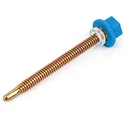
That's why we've shifted our focus. At our workshop, we're not just making more screws; we're making the ones that other manufacturers find too difficult or "not worth the trouble." We're talking about extra-long, heavy-duty hex flange self-drilling screws.

The Real Challenge Isn't Length, It's Stability
Anyone with a lathe can make a long piece of threaded rod. But a functional self-drilling screw is different. The moment you push past 100mm, you run into physics.
The Whip Effect: During high-speed installation, a long, thin screw acts like a whip. If the cold-heading process isn't perfect, the screw won't drill straight. It will wobble, create an oversized hole, and compromise the entire connection. Our process is specifically tuned to eliminate this, ensuring the drill point stays true even at 150mm or 200mm.
Thread Integrity: On a short screw, a minor flaw in the thread is no big deal. On a 200mm screw that needs to hold a significant load, that same flaw is a potential failure point. We've refined our thread-rolling dies to ensure consistent, deep threads along the entire usable length.

Why the Hex Flange Head is Non-Negotiable
You might wonder why we insist on the hex washer head design, especially for these longer screws. It comes down to torque and sealing.
Load Distribution: The integrated flange provides a larger bearing surface than a standard hex head. This is critical when you're clamping down on thick, sometimes soft, insulation materials. It prevents the head from pulling through the top layer.
The Seal: Every single one of our screws comes with a bonded EPDM washer. When you're putting a hole in a roof, that washer is your last line of defense. Under the pressure from the hex flange, it compresses to form a permanent, watertight seal that can handle thermal expansion and contraction.

Seeing is Believing: The Yellow and the White
If you look at our latest batch, you'll see two distinct colors: Yellow Zinc and White Zinc. This isn't just for aesthetics.
Yellow Zinc (Gold): This is our go-to for superior corrosion resistance. It's typically specified for harsh environments or when the fastener's lifespan needs to match the structure's, like in coastal areas or industrial applications.
White Zinc (Silver): This offers good corrosion resistance and is often used for interior applications or when a specific color match is needed.
This simple color-coding helps contractors on-site sort and use the right screw for the right job, preventing costly mistakes.
We're not just selling fasteners; we're providing a solution for the projects that can't afford to fail. When standard hardware isn't enough, that's when you need a manufacturer who understands the engineering behind the screw.