Which Industries Use Self-Drilling Screws? A Practical Guide for Today's Construction and Industrial Projects
In the fast-paced world of construction and industrial assembly, time is money. Every minute spent switching drill bits or pre-punching holes adds up to significant labor costs by the end of a project. This is where the self-drilling screw-often referred to as a Tek screw-transforms from a simple fastener into a productivity tool.
Unlike traditional fasteners that demand a three-step process (drill, tap, fasten), self-drilling screws are engineered to do it all at once. They drill their own hole, form their own threads, and clamp the materials together in a single pass. But choosing the right screw isn't just about grabbing the nearest box; it requires understanding the specific demands of your industry, whether you are securing a solar array against high winds or sealing a metal roof against torrential rain.
Here is a deep dive into the industries relying on these fasteners today, and exactly what specifications you need to look for to ensure project longevity.

Steel Structure and Pre-Engineered Buildings (PEB)
The steel structure industry is the backbone of modern infrastructure, and it is the largest consumer of heavy-duty self-drilling screws. In this sector, the primary challenge is connecting structural steel members-like C-purlins, Z-purlins, and H-beams-without the massive overhead of pre-drilling thousands of holes in a factory setting.
For steel-to-steel connections, the screw must have a hardened drill point capable of penetrating thick metal. We typically see a high demand for #3 and #5 drill points here. A #3 point can handle steel up to 6mm, while a #5 point is essential for heavier structural steel up to 12mm. If you are working on a warehouse or a workshop with pre-engineered steel frames, using a standard screw on thick beams will result in "burnout," where the drill point dulls before the hole is made, leading to structural weakness and wasted fasteners.

Roofing, Cladding, and Waterproofing
If you walk onto any commercial roofing site, you will hear the distinct sound of impact drivers securing metal sheets. This industry has unique requirements that go beyond simple holding power: waterproofing.
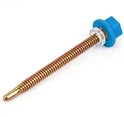
When fastening corrugated roofing sheets or PPGI (Pre-Painted Galvanized Steel) cladding, the screw must create a watertight seal. This is why hex washer head screws bonded with EPDM washers are the industry standard. The EPDM rubber acts as a gasket, compressing against the metal sheet to prevent water ingress.

A critical tip for this sector: always match the washer quality to the environment. In standard industrial zones, standard EPDM works fine. However, for coastal projects or chemical plants, you must specify high-grade EPDM or silicone washers. Standard rubber can degrade under UV exposure or chemical corrosion over time, leading to leaks that are incredibly expensive to fix post-installation.
The Sandwich Panel and Cold Storage Boom
With the global push for energy efficiency, the demand for insulated sandwich panels (PU, EPS, and Rockwool) has skyrocketed. This industry presents a specific fastening challenge: grip length.
Unlike thin metal sheets, sandwich panels are thick-often ranging from 50mm to 150mm. A standard self-driller won't work here. You need "long drill" screws that have an extended shank to pass through the insulation without damaging the core, while still reaching the structural steel purlin underneath.

In cold room installations, thermal bridging is a concern. Some advanced projects now utilize screws with specialized coatings or thermal breaks to prevent condensation from forming at the fastening point, which can degrade the insulation value of the panel over time.
Solar Mounting and Photovoltaic Infrastructure
The solar energy sector is perhaps the fastest-growing market for self-drilling screws, particularly in regions like Mexico, South America, and Southeast Asia where solar adoption is aggressive.
Solar mounting systems involve attaching aluminum or steel rails to metal rooftops. The critical factor here is galvanic corrosion. You cannot simply use a standard zinc-plated screw to attach an aluminum rail; the chemical reaction between the dissimilar metals will cause the screw to corrode rapidly.

For solar applications, we strongly recommend:
Stainless Steel (SUS 304 or 316): For high-corrosion environments.
Magni Coatings or Geomet: Advanced coatings that offer superior corrosion resistance compared to standard zinc plating, often rated for 1000+ hours of salt spray testing.
HVAC and Sheet Metal Fabrication
In the HVAC (Heating, Ventilation, and Air Conditioning) industry, speed is the ultimate currency. Ductwork installers often work in tight, awkward spaces above ceilings or in mechanical rooms.
Here, the self-drilling screw replaces the tedious process of punching and bolting. For thin sheet metal ducts (usually 0.5mm to 1.2mm), a #2 drill point is typically sufficient. However, the head style matters. Pan heads or wafer heads are preferred because they sit flush without tearing the thin metal of the duct.
Furthermore, in ventilation systems where air leakage is a performance killer, using screws with thread-forming capabilities ensures a tight seal that vibration won't loosen over years of operation.
Summary: Choosing the Right Tool for the Job
While self-drilling screws are versatile, they are not "one size fits all." To avoid project delays and call-backs, always verify three things before ordering:
Drill Point Capacity: Does the #3 point match your 8mm beam, or do you need a #5?
Corrosion Resistance: Is standard zinc enough, or do you need Magni coating for a solar farm?
Sealing Requirements: Do you need an EPDM washer for waterproofing, or a plain head for internal machinery?
By matching the screw specification to the specific industrial application, you ensure not just a fast installation, but a lasting connection.