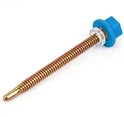
A wood screw and a self drilling screw are not the same animal. One wants deep engagement in something soft. The other wants a hole in something thin and hard. Put both jobs on one fastener and you've asked for a compromise with about two seconds to prove itself.
That's the timber to steel screw. Two materials, opposite requirements, one pass of the driver.
The order of operations is the whole problem
Timber first. Then steel.
Through the timber, the thread must not bite. Not even a little. If it grabs the wood, the screw rotates without advancing, and the timber gets pushed away from the steel instead of pulled toward it. The connection looks made. It isn't. There's a gap in there, maybe 2 mm, maybe 5, and you won't see it once the cladding goes on.
Through the steel, the same screw has to cut a hole and then form a thread in it. Fine pitch. A coarse thread in 1.5 mm steel has almost nothing to shear against.
A thread that clears wood and holds steel. Contradictory demands on one shank. Wings are how the industry settles it.
Wings, again
A wing screw carries two small flanges above the thread, wider than the thread diameter, thinner than the thread root. They ream the timber out to clearance as the screw passes through. Then they hit the steel, and they break off.
After that it's a plain self drilling screw doing machine work in steel.
I keep telling buyers the shear point is the specification, not the wing. Ask at what torque the wing lets go. If nobody can answer, the part is a guess with a certificate attached.
Wing geometry has to match the steel gauge. Too thick a wing, or too thick a steel, and drilling torque climbs past the shear point before the wing reaches the plate. The wing goes early, up in the timber, and the thread cuts wood that should have stayed clear. Jacking again, from the other direction.
Three ways people buy this
The winged screw is the default, and the right answer in thin steel.
Then there's the plain self drilling screw with a coarse thread, used where the timber is soft or thin enough that jacking won't happen, or where a gap doesn't matter. Cheaper. Fine for a shed. Wrong for anything a structural wood screws schedule covers.
And two-part systems. A steel screw, a separate washer or bracket, timber and steel fastened independently. It isn't a screw solution at all. Sometimes it's the right one anyway, where the connection is engineered and somebody has run the numbers.
What goes wrong on site
Jacking, above all. It's the signature failure of the category and it's invisible at handover. The thread engaged the timber, the screw spun, the member walked away from the steel. You end up with a joint held apart by air.
Wing shear at the wrong moment does the same damage differently. Early shear and the thread cuts wood. Late shear and the wing opens the hole in the steel, so the thread has nothing left to bite. Both look identical from outside: a screw that turns and doesn't tighten.
Not enough steel engagement is the quiet one. Length is timber plus steel plus washer allowance, and you want three full threads in the steel at minimum. On 1.5 mm steel with 1.8 mm pitch that's 5.4 mm of thread below the plate. More than most people budget for.
Splitting is geometry more than a screw problem. Too close to an end, too close to an edge, too big a diameter for the species. Predrill or drop a size.
Corrosion at the interface is the one nobody specifies until a claim lands. Copper-based preservative treatments are hard on zinc, so damp service with treated timber needs stainless or a heavy barrier coating written onto the order.
The numbers that matter
For structural work the fastener is a structural element. Specify it like one.
Withdrawal capacity in the steel depends on engaged thread length and plate thickness. Lateral capacity comes from the screw's shear strength and the timber's embedment. Slip is the one everybody forgets: a winged screw has clearance in the timber, so the joint moves before load transfers. In a diaphragm or shear wall that's a design input. Not a detail.
Then fire and duration-of-load factors, per the code you're building to. Not a screw property, but the screw's capacity goes into the arithmetic.
Most of these numbers come out of the manufacturer's test data. A supplier who can't produce a test report for the exact product isn't selling a structural fastener, whatever the box says.
What to put on the order
Diameter, length, thread form, point type, wing or no wing, coating, and the steel gauge range the product was tested against.
Add timber species and moisture condition. Capacity changes with both, and not by a little. I've watched two batches of one species, different moisture content, behave differently enough that one wall had gaps and the next didn't.
Drive perpendicular to the steel, which isn't always perpendicular to the timber face. Don't over-drive, because the head or washer crushes the timber and the clamp goes with it. Check the first ten fasteners of every new timber batch for jacking. Keep end and edge distances above the code minimum, usually given in diameters so nobody memorises a millimetre figure.
Handan Dongchao Hardware Products Co., Ltd. has been cold heading and thread rolling in Handan, Hebei since 2008 - roughly 600 tonnes a month across 100 cold heading machines, 75 thread rollers, 30 tail drilling machines and two heat treatment furnaces. Winged parts run through three of those in sequence - wing in the heading die, point tail drilled, heat treatment setting the shear torque. Get the sequence right and the connection works. ISO and CCC certified, exporting to the US, UK, UAE, Saudi Arabia, Vietnam and Korea.
The line to remember
One material has to be reamed. The other has to be threaded. Everything depends on which happens first, and where the changeover lands.
Specify the wing. Specify the steel gauge. Check for jacking on site. A gap you can't see is a connection that isn't there.