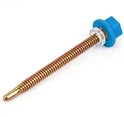
Walk a metal building site and count head styles. Nearly everything will be a hex washer head.
Not because it's the best head. Because it solves the most problems at once, and metal building work has an unusual density of problems. Knowing why it won tells you where to stop using it.
What the part actually is
A hexagon head with an integrated oversized flange - the washer - formed in the same heading operation. Usually with a bonded EPDM washer underneath when it has to seal.
Six flats for a socket, so engagement is positive and torque capacity is high with little cam-out risk. A bearing surface much wider than the head, spreading clamp load over a bigger annulus of sheet. A low profile relative to a standard hex head, because the flange is thin. And a flat underside designed to compress a bonded washer evenly.
That's it. Nothing clever. The cleverness is that all four arrive together at a price a pan head plus a separate washer can't touch.
Why it took the market
It stays on the bit. A hex head holds itself on the driver, which matters when your other hand is holding a panel in wind. Cross recess heads need axial pressure; a hex socket holds by geometry, so the tool hangs there while you position the sheet.
It takes torque. Metal building screws go into purlins with powered tools at high speed, and a hex drive transfers far more before failing than a Phillips. It also doesn't cam out as the bit wears, the failure that rounds out recesses all afternoon.
It spreads load. A 0.5 mm sheet dimples under a small head. The flange spreads clamp over enough area that the sheet stays flat, and flat matters twice: appearance, and a washer sealing better against flat than dished.
It seals. The flat flange is a good seat for a bonded EPDM washer, and the pair works on profiled sheet where a bare head wouldn't.
And it comes apart again. A standard socket removes and re-drives it, worth something on panels that come off for maintenance.
Where it's the wrong part
Where the head has to be flush. An hwh screw sits proud. In architectural cladding, where fasteners are supposed to disappear, this is the wrong part, and painting the head doesn't make it invisible. It makes it a painted visible head.
Where the head meets feet or abrasion. The flange is thin and it deforms. Walk across it, drag a ladder over it, and you'll see.
Where the sheet is very thin or soft. On 0.4 mm sheet or a composite panel, even a flange can dish the surface, and a wafer head may be the only thing that doesn't.
And where access is tight. A socket needs radial clearance. In a corner, a low-profile pan head with a Torx drive may be the only thing that fits. No amount of torque capacity helps if the socket won't go on.
The interface nobody specifies
What decides whether a hex washer head self drilling screw seals isn't the hex. It's how the washer sits on the flange.
A bonded washer vulcanised to the flange can't rotate, so compression is controlled by drive depth and nothing else. A loose one can rotate during driving, and if the flange has any texture or the washer gets dragged, compression goes uneven before the head is down.
Two screws can look identical on a datasheet and behave differently on a roof for that reason alone. It's why the washer description belongs on the same line of the order as the head description.
Diameter and length
Because the head is large, these self drilling screws get chosen a size bigger than a pan head would need. Common metal building sizes sit around 12 and 14 gauge - roughly 5.5 mm and 6.3 mm - for sheet-to-purlin work, smaller for light sheet, bigger for structural connections.
Length follows the usual logic. Total thickness to be drilled, plus washer compression allowance, plus at least three full threads engaged in the purlin.
That allowance is small and always forgotten. A bonded EPDM washer compresses roughly 1 to 1.5 mm at correct torque. On a marginal calculation that's the difference between three threads and two, and two threads on a thin purlin pulls out under wind load.
Coating, which is a flange problem
The flange is where coating gets difficult. It's a thin wide surface at the extreme edge, and coating thickness there is where corrosion starts on a metal roof.
Zinc flake coating covers flange and thread evenly, which is why it's common across this family. Hot dip is impractical at these sizes because it bridges the thread and rounds the hex until the socket doesn't fit.
And the underside of the flange is a crevice. Water sits in it. A coating that passes on a flat coupon can still fail in the flange-to-washer crevice, which is one more reason to specify by test method rather than coating name.
What to write on the order
Head style, drive and socket size, diameter, length under head, thread form and pitch, point number, washer type and bonding method, coating with its test method, and total thickness to be drilled.
Then add the panel profile. On trapezoidal sheet, crest or pan changes both the length you need and the way it seals, and it's the detail most often left to the installer to guess.
Handan Dongchao Hardware Products Co., Ltd. has been cold heading and thread rolling in Handan, Hebei since 2008, at around 600 tonnes a month across 100 cold heading machines, 75 thread rollers, 30 tail drilling machines and two heat treatment furnaces. On this family the head and flange come out of a single heading operation, so flange concentricity and washer seating are die questions before they're anything else. ISO and CCC certified, exporting into the US, UK, UAE, Saudi Arabia, Vietnam and Korea.
The short version
Hex washer head won because it holds itself on the bit, takes torque, spreads load and gives a washer a flat seat. Four problems, one part.
Use it where those four things matter. Use something else where the head has to disappear.