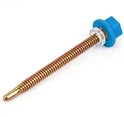
Two screws on the bench. Same M3, same length, same plating. One goes into an ABS boss and the product ships for eight years. The other splits the boss before it's seated, and the split turns into a hairline three days later, after the housing is painted and nobody can rework it.
The difference isn't price. It's whether the screw moves plastic aside or removes it.
Displacing, or removing
A thread forming screw pushes material aside. Polymer flows around the flank, packs the space, then relaxes back against it. Nothing leaves the part. What holds the screw afterwards is residual stress inside a boss that's still whole.
A thread cutting screw has an edge - usually a slot or a notch cut across the point - and it takes a chip. Material is removed. The thread sits in a cut groove, and the boss isn't preloaded the way a formed joint is.
Both work. Neither is better in the abstract. What decides is the polymer, the wall thickness, and how many times somebody opens the thing.
Where forming is the right call
Semi-crystalline and amorphous thermoplastics with some elongation in them. ABS, polycarbonate, nylon, thicker-section polypropylene. These flow around the profile and settle. You get a joint that resists loosening without any locking feature, because the interference is doing the work.
Single assembly, never reopened. That's the sweet spot. What the trade calls a pt screw is essentially this - coarse pitch, wide flank, built to displace rather than cut, and cheap because the die is simple.
Thin bosses too. A cut groove removes wall material from a section that didn't have any spare.
The catch is hoop stress. Forming loads the boss outward. Too much interference and it cracks, sometimes while you watch, sometimes a fortnight later when the stress finds the weak point. Boss outer diameter, wall thickness, a radius at the base - those matter as much as anything on the screw drawing.
Where cutting wins
Glass-filled grades, most thermosets, some styrenics. These don't flow, they fracture. A forming screw in a glass-filled nylon boss is a dependable way to produce a split, and no pilot-hole tuning fixes a material that won't deform.
Large diameters in hard plastic, where a forming screw's driving torque would exceed what the boss can survive.
Joints that come apart. A cut thread has clearance rather than interference, so it takes repeated insertions better. Every cycle costs a formed thread some material. A cut thread loses less.
Long bosses as well. Torque accumulates down a forming screw, and past a certain depth the last threads ask for more than the driver can give.
The middle path
Hi-Lo. Alternating high and low threads on one shank.
The low thread opens a path at low torque. The high thread follows in that path and does the holding. Driving torque drops toward what a cutting screw needs, holding capacity stays closer to a forming screw.
For thin-wall plastics, PVC, and the case where a standard self tapping screw strips and a cutter sits too loose, Hi-Lo is usually the answer that gets signed off.
Four numbers decide it
Pilot hole diameter first, because it's the most important number and the one most often missing from the drawing. Forming screws want a pilot around 80 to 90 percent of minor diameter in the specific polymer. Cutting screws want closer to minor diameter, or a touch over.
Too small and the boss cracks or the screw shears. Too large and nothing engages. There's no generic figure. It moves with the grade.
Boss outer diameter second. Rule of thumb for forming: two to two and a half times the screw's major diameter. Under that, hoop stress wins and the radius at the base won't save you.
Engagement depth third. Two to three times diameter. Going deeper buys very little and adds torque you pay for at the driver.
Drive speed last, and it's the one production always forgets. Plastic is viscoelastic. Drive fast and the material can't flow, so it shears, and the preload you thought you had is gone. Slower than metal. Always slower than metal.
What actually fails
Cracking at the base of the boss. Hoop stress meeting a sharp corner. Fix the radius before you change the screw, because a different screw in the same bad boss only changes the date.
Stripping during installation. Pilot too big, or a clutch set for metal work. Plastic has a narrow torque window - enough to seat, not enough to shear the formed thread. Most drivers aren't set anywhere near that window.
Preload walking away over months. Plastic creeps. A joint that was tight at assembly relaxes, and torque at the driver doesn't fix creep. You need a spring element or a shoulder that stops compression.
Environmental stress cracking. Some polymers crack under load in the presence of particular oils, solvents, detergents. The screw creates the stress, the environment finishes the job. That's a material compatibility question, and no fastener supplier can answer it.
And repeated disassembly eating the thread. Each removal takes a little material off a formed thread. Serviceable joints get cutting screws, inserts, or a machine screw into a moulded thread. That's the whole list.
Specifying a plastic screw properly
The fastener is half the information. The other half is polymer grade, whether it's filled, the boss geometry, and how many assembly cycles the product will see.
With those four, selection becomes determinate. Without them, a supplier can only quote something that worked in a sample somebody else moulded.
Handan Dongchao Hardware Products Co., Ltd. cold heads and thread rolls in Handan, Hebei, at around 600 tonnes a month on 100 cold heading machines and 75 thread rollers, and has since 2008. On a plastic screw the roll die geometry sets driving torque - the Hi-Lo alternating profile especially - and driving torque is what decides whether the boss survives the assembly line. ISO and CCC certified, exporting to the US, UK, UAE, Saudi Arabia, Vietnam and Korea.
Short version
Forming pushes plastic aside and leaves it stressed. Cutting takes plastic away and leaves it clear.
Match the mechanism to the polymer. Then fix the pilot hole. A screw can't rescue a boss that was never given room for it.