A buyer asked me once why our stainless range stopped at 410. He wanted 316. Coastal job, he'd done his homework, he knew 316 was the good one.
He wasn't wrong about 316. He was wrong about what a drill point needs.
Cutting steel takes hardness. Chloride resistance comes from a different corner of the metallurgy, and in practice the two pull against each other. 316 can't be hardened, so it can't be a point. That's the whole answer, and it takes thirty seconds to explain and about three emails to lose the argument anyway.
Three families, one of which cuts
Austenitic is 304 and 316. Chromium-nickel, non-magnetic, excellent corrosion resistance, and they work harden. You can't harden them by heat treatment at all, only by cold working - which is precisely what you'd be doing while forming a point and rolling a thread. The material gets harder as you fight it and never hard enough where you need it.
Martensitic is 410 and its relatives. Chromium, no nickel, magnetic, hardenable by heat treatment. Form the point, heat treat it, and it will cut mild steel while staying resistant enough for plenty of environments. Not a cost decision. It's the only family that works.
Ferritic is 430 and similar. Low carbon, magnetic, not hardenable. Decent corrosion resistance, poor cutting tool. You'll see it in sheet and trim, not in points.
Why 410 carries the self drilling market
12 to 14 percent chromium. Enough for atmosphere. Not enough for chloride, and no amount of marketing changes that.
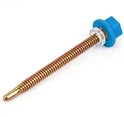
Heat treated to the right hardness, a 410 stainless steel screw will drill and thread mild steel up to a few millimetres, which covers most sheet-to-purlin work in the world.
Its limits are specific. Magnetic, which matters for sorting equipment. Corrosion resistance substantially below 304 and well below 316. The hardness that makes the point work costs toughness, so it's more brittle than a 304 stainless steel screw and doesn't like being bent. And near a coast it will show rust spots.
That last one causes more supplier disputes than everything else on this page. A customer buys "stainless" screws, installs them 800 metres from the sea, finds brown speckles eighteen months later, and files a claim. Nobody sold him a defective part. He bought 410 for a job that needed 316, and 316 can't be made into the part he wanted. Both true, and neither one helps him.
What 304 is actually for
18 percent chromium, 8 percent nickel. General purpose: machine screws, bolts, washers, nuts, anything into a pre-formed hole where no drilling happens.
It handles atmosphere and a lot of chemicals, works up to several hundred degrees Celsius, and galls like nothing else when you run it against itself. Stainless on stainless, dry, driven fast: the threads cold-weld and the assembly is now permanent.
Anti-seize isn't a suggestion on a 304 assembly. It's a maintenance requirement, and I've watched a fitter destroy a bracket proving it.
304 work hardens, which is why tapping it needs sharp tooling and a slower speed than mild steel.
What 316 buys, and what it costs
Add 2 to 3 percent molybdenum and chlorides stop deciding the argument. Coastlines, food processing, pharmaceutical rooms, anywhere salt or a chloride cleaner lives.
It's dearer. It's also softer in practice than 304 and galls more readily, which surprises people who assume the higher grade is better at everything.
And it can't be hardened, so it can't be a drill point. A 316 stainless steel self drilling screw doesn't exist in any meaningful commercial sense. What exists is a 316 machine screw into a pre-drilled hole, or a coated carbon screw with a service-life calculation and a shorter warranty.
Design around that. Don't order a grade that isn't made.
| Environment | Drilling required | Recommendation | |---|---|---| | Dry interior | Yes | Zinc coated carbon steel | | Dry interior | No | 304 | | Exterior, inland, sheltered | Yes | 410, or coated carbon steel | | Exterior, inland, exposed | Yes | Zn-Al coated carbon steel | | Coastal, within ~1 km | Yes | Zn-Al/Zn-Al-Mg carbon, or 316 pre-drilled | | Coastal | No | 316 | | Chemical / food / pharma | No | 316, sometimes 316L | | High temperature | No | 304 or 316, by atmosphere |
The pattern is blunt. If the joint needs the fastener to drill its own hole, you're not getting 316. Everything else follows from that.
Galling, which destroys assemblies quietly
Stainless threads seize because the passive chromium oxide layer breaks down under pressure and the metal underneath cold-welds. Once welded, it isn't coming apart without damage to something else.
Four things help, and I'd use two of them together. Anti-seize on assembly, especially on 304 and 316 pairs. Slower driving and lower torque than carbon steel would take. Avoid stainless nut on stainless bolt where the design allows - mix grades, or use a coated nut. And specify a lubricated or passivated finish on anything that will be serviced.
None of that costs much. All of it gets skipped.
What goes on the order
The grade, named explicitly, plus the standard and condition it's made to. "Stainless steel screw" covers four families with completely different behaviour, so the phrase on its own isn't a specification.
Then the environment. A supplier who knows the fastener is going within a kilometre of salt water will tell you 410 will stain. That conversation costs nothing and it's worth more than the price difference.
Handan Dongchao Hardware Products Co., Ltd. has been cold heading and thread rolling in Handan, Hebei since 2008, at around 600 tonnes a month on 100 cold heading machines, 75 thread rollers, 30 tail drilling machines and two heat treatment furnaces. Grade selection comes before manufacturing, and the heat treatment step is what turns a martensitic grade into something that can cut. ISO and CCC certified, exporting into the US, UK, UAE, Saudi Arabia, Vietnam and Korea.
The short version
304 resists corrosion. 316 resists chlorides. 410 drills. Pick two, and the joint detail picks for you.
Choose the detail first. The grade then becomes a short list instead of an argument.