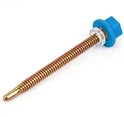
A specification arrived on my desk once with the coating line filled in as: "zinc plated, good quality".
Four words doing the work of a materials decision.
I called the buyer. He wasn't being careless. He didn't know that four zinc-based coatings sit in commercial use on fasteners, spread across a factor of twenty in corrosion performance and three in cost. "Good quality" resolves to whatever the plant ran that week.
Electroplating, the one everybody means
A thin bright deposit, 5 to 12 microns, applied in a barrel or on a rack. It's sacrificial. The zinc corrodes so the steel doesn't, and when the zinc is gone the steel goes.
Neutral salt spray gives a few dozen hours at the thin end, a couple of hundred at the thick end with decent passivation. Narrower than most datasheets admit.
Indoors, a zinc plated screw at 8 microns with proper passivation is cheap and entirely sensible. Put the same screw on a coastal roof and you've bought two years.
Hot dip galvanized, the thick one
Immersion in molten zinc. Metallurgically bonded, 45 to 85 microns, often more. Many hundreds of hours of salt spray, over a thousand with a heavy coating.
The costs aren't financial so much as dimensional. Hot dip builds thickness on the thread, so nuts get tapped oversize and bolts have to be paired with those nuts or nothing fits. It also rounds off fine features, which rules it out for small self drilling screw sizes where the point and the thread crest both need to stay sharp.
Specify it on a 12-gauge roofing screw and you get a part that won't drill properly. Hot dip belongs on structural work.
Zinc flake, and what people mean by dacromet
Zinc and aluminium flakes in a binder, dipped, spun, cured. 8 to 15 microns.
It coats evenly over threads and points without bridging, and it puts no hydrogen into the steel, which is why it took over high-strength work. Performance sits in the several hundred to over a thousand hour range.
Buyers ask for dacromet by name. Half mean the zinc flake coating family as a whole. The other half mean one OEM's approval number and can't say which. Commercially that matters. Technically they're cousins.
Zn-Al and Zn-Al-Mg
Hot dipped, or applied continuously to the wire before heading. 10 to 25 microns.
The magnesium does one specific thing. It stabilises the corrosion product at a cut edge, and the cut edge is where every zinc coating is weakest - the drilled hole, the thread crest, the sheared end. Bare steel by definition, whatever went on before.
That's why this family owns coastal roofing and solar now. Not elegance. The warranty claims stopped.
Phosphate, which isn't a barrier at all
2 to 5 microns, black, a conversion coating rather than a deposit. It holds oil. It gives paint something to grip.
A black phosphated drywall screw in a dry interior is the right part at the right price. The same screw in a damp cardboard box rusts before it reaches site, and I've opened that box.
| Coating | Typical thickness | Salt spray (indicative) | Cost index | Best use | |---|---|---|---|---| | Electroplated zinc | 5–12 µm | 50–200 h | 1.0 | Interior, sheltered | | Phosphate (black) | 2–5 µm | Very low | 0.8 | Dry interior only | | Zinc flake | 8–15 µm | 500–1000+ h | 2.0–2.5 | High strength, exterior | | Hot dip galvanized | 45–85 µm | 800–1500+ h | 2.5–3.5 | Heavy structural | | Zn-Al / Zn-Al-Mg | 10–25 µm | 1000+ h | 2.5–3.5 | Coastal, roofing, solar |
Those hours are a range, not a promise. A number without a failure criterion means nothing.
Three failures buyers miss
Hydrogen embrittlement tops the list and nobody inspects for it. Electroplating generates hydrogen at the cathode, which is your part, and high-strength steel absorbs some. A 10.9 or 12.9 bolt that took it in can fail weeks later with no corrosion and no deformation first. The fix is a post-plating bake, and the requirement is invisible in a part number.
Galvanic mismatch comes second. A zinc coated screw in aluminium makes a corrosion cell, and the aluminium loses. Roofing and cladding put those metals together constantly, so an isolating washer isn't a refinement. It's the difference between a ten-year detail and a three-year one.
Edge exposure explains more rust complaints than anything else. Every coating is thinnest where it matters most. Plated screws rust at the thread crest first.
Putting it on the order
Screw coating type by chemical family, not a trade name alone. Thickness or weight in microns or grams per square metre, measured where it matters rather than on a coupon. Test method and duration - ISO 9227 neutral salt spray or a cyclic test, with hours attached. And the failure criterion: first red rust, or a percentage of area, tested on the part.
That last field goes missing, and it changes the answer. A flat coupon has no thread and no hole. Its result describes a coating, not a fastener.
Then environment. Dry interior, phosphate or thin electroplate. Sheltered exterior inland, zinc flake or heavy electroplate. Exposed inland, zinc flake or hot dip. Coastal or a twenty-year life, Zn-Al or stainless. At 10.9 and above, zinc flake, or electroplating with a bake you can document. Aluminium in contact, isolate it.
In that order the answer is usually obvious. It's rarely the cheapest.
Handan Dongchao Hardware Products Co., Ltd. has been cold heading and thread rolling in Handan, Hebei since 2008, at around 600 tonnes a month across 100 cold heading machines, 75 thread rollers, 30 tail drilling machines and two heat treatment furnaces. Coating is the last operation in that chain and the easiest to substitute, which is why the thickness on the drawing and the thickness on the part deserve separate checks. ISO and CCC certified, exporting into the US, UK, UAE, Saudi Arabia, Vietnam and Korea.
The short version
Five coatings, five price points, twenty times the range. "Zinc plated, good quality" specifies none of them.
Pick the environment first. The coating follows, and it's almost never the cheap one.