A fastener fails under load in one of two ways. It deforms first, and you get warning. Or it snaps with no deformation at all.
The second kind ends up in a report. Hydrogen embrittlement is its most common cause in plated high-strength fasteners, and it's the only failure mode I know of where the defect is created after the part is finished, passes every dimensional check, sits in a warehouse, installs cleanly, and lets go weeks later.
What's happening inside the steel
Hydrogen atoms are small enough to diffuse into steel and keep moving.
Electroplating generates hydrogen at the cathode, and the cathode is your part. Most of it bubbles off. Some doesn't. That fraction is the problem.
Once inside, hydrogen migrates to regions of high triaxial stress - thread roots, the transition under a head, the tip of a notch. There it does something specific and nasty. It reduces local ductility without reducing tensile strength. The bolt doesn't get weaker on paper. It loses the ability to yield, so under load it goes from elastic straight to fracture, with no necking, no stretch, no warning.
The signature is always the same. Torqued correctly, sat for days or weeks, failed well below rated load, brittle fracture surface, no deformation. Nobody believes it until it's their batch.
Which parts are at risk
Risk scales with hardness, and hardness scales with property class.
Class 8.8 is low practical risk. Not zero, low. Class 10.9 is the main zone, and it's the class where bake requirements are written into the standard because the industry learned the hard way. Class 12.9 is the highest risk, and it's where a supplier's process discipline shows.
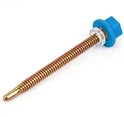
Case-hardened parts are the underrated category. A self drilling screw point is a locally hardened region on a screw that might be a low property class overall, and point embrittlement is real. Spring washers and retaining rings are high hardness by design and get overlooked constantly, because they're cheap and nobody thinks of them as structural.
There's a persistent belief that this is an automotive problem and doesn't touch construction. Drywall screws at low class, fair enough. A high strength bolt at 10.9, solar mounting hardware, anything with a hardened point, not fair enough. A 12.9 zinc plated screw in a curtain wall is that part, and it fails in week three.
Baking, and doing it properly
After plating comes fastener baking, to drive hydrogen out. Three parameters matter.
Temperature, typically 190 to 220 °C for most specifications. Too low and diffusion is too slow to accomplish anything. Too high and you start affecting the coating or the base hardness, which trades one problem for another.
Time, commonly four hours, longer for higher classes, measured from when the parts reach temperature. Not from when the oven was switched on. That distinction has caught out more than one plant.
Delay before baking is the parameter that gets missed, and it's the one that can't be fixed later. Hydrogen keeps diffusing and keeps accumulating at stress concentrations while the batch sits in a basket. A batch that waited two days cannot be rescued by a longer bake. Standards typically require baking inside a defined window, often a few hours, after plating.
A supplier can truthfully write "baked at 200 °C for 4 hours" and still have a problem if the parts waited 48 hours first. Every word true, and the part still compromised.
What you can verify, which isn't much
There's no non-destructive test for hydrogen embrittlement. None. You can't inspect for it afterwards, so verification is process-based, and it comes down to a few questions asked before the order.
Was the part electroplated, or coated by something that doesn't generate hydrogen? Zinc flake coating, hot dip and mechanical plating all avoid that exposure, and they're the standard answer for high-strength parts where baking is impractical or not trusted.
What's the bake specification, and what's the maximum delay between plating and baking? Ask for both numbers. A supplier with an answer for the first and a shrug for the second hasn't controlled anything.
Is there a record per batch? A time-and-temperature chart is the only evidence that exists. Not a certificate.
And is there a test? For critical work, a sustained load test or a bend test on a sample from the batch. Sampling, not a guarantee. I'd still rather have it than not.
The design side, which is cheaper
Two decisions remove most of the risk before plating is even discussed.
Don't specify a higher property class than the joint needs. A 12.9 bolt where 8.8 carries the load is a decision to buy risk for nothing. Higher class, higher hardness, higher susceptibility, and the capacity was never required.
Use a non-electrolytic coating on high-strength parts. Zinc flake exists for this. It costs more per part and less than one field failure.
Geometry matters too. Sharp notches concentrate stress and hydrogen at the same point. A generous thread root radius and a smooth head-to-shank transition cost almost nothing in design and do real work in service. Fastener heat treatment sets the hardness, and hardness is what the risk curve runs on.
What to add to the purchase order
For anything at 10.9 or above, or any case-hardened part, one line covers it: coating method, plus the post-coating bake specification including the maximum delay to bake.
That line is the difference between a coating spec and a coating spec that addresses the one failure mode nobody can inspect for.
Handan Dongchao Hardware Products Co., Ltd. has been cold heading and thread rolling in Handan, Hebei since 2008, at around 600 tonnes a month across 100 cold heading machines, 75 thread rollers, 30 tail drilling machines and two heat treatment furnaces. Two furnaces and a written process record are what make a hardness spec repeatable batch to batch. That is the whole game. ISO and CCC certified, exporting into the US, UK, UAE, Saudi Arabia, Vietnam and Korea.
The short version
Hydrogen enters during plating, collects at stress concentrations, and takes away the fastener's ability to warn you before it breaks.
You can't test for it afterwards. You can only specify how it's prevented, and then ask for the record.