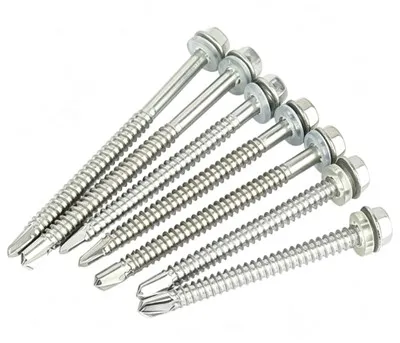
There is a carton in my office with his logo on it, four colours, gone slightly soft at the corners from sitting on a shelf. Inside it there is one screw, and the screw has turned the colour of a brick.
He brought it in himself, in a plastic bag, and put it on my desk between us and did not say anything for a while. Then he said my screws had rusted.
I said they were not my screws. His name was on the box.
I knew that was a poor answer while I was giving it, and I have had two years to work out why. It was true, which is the worst kind of poor answer. It was true and it did not help him and it did not make me right.
He bought carbon steel because the drawing said carbon steel
The order came in as an OEM enquiry, which means the carton carries the buyer's brand and not mine. Five hundred thousand structural timber screws for decking, M8 by 80, hex head, going into a system he sells through garden centres and small builders' merchants in three countries.
The drawing said carbon steel. I quoted carbon steel. There was a second line on the quotation for zinc plating and it added eight percent, and he took it off because his own customers, he told me, never look at the head of a screw.
He was not wrong about that either. Nobody looks at the head of a screw until it goes orange.
The part I keep coming back to is that I gave him a quotation with a coating as an option, and a decking screw with the coating as an option is a quotation for two different products. One of them is a decking screw. The other is a screw with a shape that fits a deck and no protection at all, and it will hold for one season and be a liability for the next fifteen.
A deck is not a wet place, it is a place that dries out
People hear decking and they think rain, and rain on a vertical surface is not the problem. The problem is the five millimetre gap between the deck boards and the countersink the head sits in, which is a small cup pointing at the sky, and there is one of those cups for every deck board fixing on the job.
That cup holds water after every shower and releases it over the next six hours. Do that two hundred times a year and you have a piece of steel sitting in an alternating wet and dry cycle, which is the condition that removes zinc fastest and removes bare steel almost as fast as it can.
I have pulled bare carbon screws out of decking at six months and found red at the head and the top of the thread, with the shank still bright, and the reason is that the head is where the water stops. At eighteen months the same screw has lost enough section at the head that the head snaps off before the thread pulls out, and the board lifts under a foot and somebody falls.
That is not a coating story. That is a section loss story, and the steel was doing exactly what carbon steel does.
What I should have asked, and did not
The OEM service I run asks for the drawing, the quantity, the packing and the delivery date. Four things. I have run hundreds of orders that way and every one of them was compliant, and compliant is a word that means the parts match the paper and says nothing at all about whether the paper was right for the job.
The question I never asked was where the screw was going. Not what the customer wanted, because he told me that and he told me carbon steel. Where it was going. A deck is a different place from a cabinet, and an M8x80 is used in both of them.
I am not going to pretend a single question would have changed his mind about eight percent, because a man who is buying five hundred thousand pieces is buying a price and he would have argued. What the question would have done is put the argument on the table in week one instead of in year three, when the only person still in the room is his dealer holding a bag of orange screws.
What changed on my side
Any OEM enquiry that involves a screw with a head designed to sit in timber now gets one extra line in my reply, before the price. I ask what the fastener is fixing and whether it will see weather. If the answer is a deck, a fence, a pergola, anything outdoors, the coating stops being an option on the quotation and becomes the first item, and the plain version comes off the sheet entirely.
I lose a little business this way. Two enquiries last year went to a mill that quoted plain without asking, and both of them were cheaper than me by about six percent, and one of those customers is now someone I would like to hear from in two years.
The other thing I did was stop printing the coating as a percentage. Eight percent of a screw that costs a few fen is a number small enough to wave away, so now the line says the coating weight and the salt spray hours and the expected service life in a deck, and it is a much harder line to take off a sheet.
He came back for something else
He did not come back for decking screws. He came back eighteen months later for a different product entirely, and when we had finished that conversation he asked whether I would still print his logo.
I said I would, and I asked where the screws were going, and he told me, and we picked a coating together and he paid for it. The container went out in March.
The carton with his four colours is still on the shelf behind my desk. I keep it there because every OEM enquiry that lands on me now gets read against it, and the question I ask first is not how many.
Hot Tags: carbon steel structural timber screws, timber screws for decking, oem timber screws, decking screw coating, plain carbon steel screws, deck board fixing, hex head timber screw