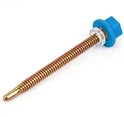
In the vast systems of machinery and architecture, screws may be among the most inconspicuous components. Yet, these metal components, measuring just a few millimeters in diameter, have become an indispensable foundational element of modern industry thanks to their unique advantages. From precision instruments to skyscrapers, screws, despite their seemingly simple structure, carry complex functional requirements.
Reliability and fastening are the core advantages of screws. By interlocking the threads with the screw holes, screws securely fasten two separate components, maintaining a stable connection even under dynamic conditions such as vibration and shock. Compared to welding or riveting, screws allow for rapid disassembly and reuse, a reversibility crucial for equipment repair and modular assembly. For example, engine assembly on automotive production lines requires frequent assembly and disassembly of components, and the reusable fastening properties of screws significantly improve production efficiency.
Another key characteristic of screws is their wide adaptability. By varying thread specifications, head shapes (e.g., hexagon socket, cross recess), and materials (stainless steel, titanium alloy, etc.), screws can meet diverse requirements, from tiny screws for electronic devices to anchor bolts for bridges. In the electronics industry, micro self-tapping screws can form threads on thin aluminum sheets, solving the problem of fastening in lightweight structures. In aerospace, high-strength titanium alloy screws ensure flight safety with their weight reduction and corrosion resistance.
Cost-effectiveness further highlights the industrial value of screws. Standardized production makes screw manufacturing and maintenance costs extremely low, and globally unified thread standards (such as the ISO metric thread) enable cross-regional component interoperability. A common M6 screw costs less than one yuan and yet delivers hundreds of Newton-meters of tightening force, a price-performance ratio unmatched by other connection methods.
More deeply, the advantages of screws are essentially the product of human engineering ingenuity-through the mechanical optimization of the helical structure, simple rotational motion is converted into powerful axial force. In modern manufacturing, where precision and efficiency are paramount, these micro components continue to prove that true industrial strength often lies in overlooked details.