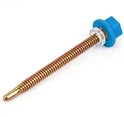
Screws, seemingly simple mechanical components, are essential components in modern industry. They consist of a shank, a nut, and threads. Through their ingenious helical structure, they convert rotational motion into linear motion, thus achieving the function of fastening or connecting.
The core of a screw lies in the thread-the spiral groove that encircles the shank. The angle of the thread determines the tightness of the screw, with coarse and fine threads being common. Coarse threads offer high strength and are suitable for bearing heavy loads, while fine threads are more precise and are often used in thin-walled materials or where loosening is required. The thread and nut work together through friction and mechanical engagement to secure objects, a design that is both simple and effective.
Screws are typically made of metal (such as steel, stainless steel, and aluminum) or engineering plastics. Steel screws are strong but prone to rust; stainless steel screws are corrosion-resistant and suitable for use in humid environments; and plastic screws are lightweight and insulating, often used in electronic equipment. Surface treatments such as zinc plating, nickel plating, or blackening can further enhance a screw's corrosion resistance.
Despite their small size, screws embody a remarkable feat of engineering ingenuity. Their design prioritizes not only tightening force but also ease of installation. For example, hexagon socket screws secure with a wrench, preventing slippage; self-tapping screws can be screwed directly into soft materials without pre-drilling; and expansion screws, with their expansion tubes, provide enhanced grip, making them suitable for fixing to concrete or brick walls.
Screws are ubiquitous in everyday life and industrial production-from furniture assembly to aerospace, from mobile phone repair to bridge construction. They employ the simplest of structures to solve practical problems, demonstrating the engineering wisdom of "using simplicity to master complexity." The next time you tighten a screw, consider the larger design behind this tiny part.