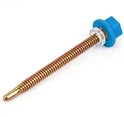
Having spent over a decade in mechanical engineering, I've spent more time working with bolts than with my family. These seemingly simple cylindrical metal parts are, in fact, indispensable "unsung heroes" of the industrial world. From the precision screws in microelectronic devices to the giant bolts in heavy machinery, they silently withstand tension, compression, and shear forces, maintaining the integrity and safety of entire structures. Today, I would like to share some of my experiences and reflections on bolt handling, accumulated through years of practical experience. These may not be textbook knowledge, but they are valuable insights gained through repeated experience in the real world.
Bolt Selection: More Than Just Diameter and Length
When I first started in the industry, I naively believed that bolt selection simply depended on whether it was M10 or M12 on the drawing and that the length was sufficient. It wasn't until I was overhauling equipment that a flange connection on a critical machine suddenly leaked. Inspection revealed that the cause was improper bolt specifications. To save costs, the designer had selected bolts with a lower strength grade, which resulted in plastic deformation under normal operating pressure. This lesson taught me that selecting bolts is about more than just matching size.
First, the performance grade of the bolt must be determined based on the application. Common carbon steel bolts come in grades 4.8, 8.8, 10.9, and 12.9. The first digit represents 1/100 of the material's tensile strength (measured in kgf/mm²), while the second digit represents 10 times the ratio of yield strength to tensile strength. For example, a grade 8.8 bolt has a tensile strength of 800 MPa and a yield strength of approximately 640 MPa (800 x 0.8). While high-strength bolts are slightly more expensive, they are definitely worth the investment for applications involving dynamic loads or critical connections.
Second, bolt length isn't necessarily "longer, better." I've seen countless cases where excessively long bolts prevented nuts from tightening or interfered with other components. The correct bolt length should ensure that two to three full threads are exposed after the nut is tightened. Too short may result in inadequate thread engagement, while too long wastes material and can cause other problems. For blind hole connections, sufficient space below the bolt head must also be considered.
Material selection is also crucial. Standard bolts are mostly made of carbon steel or alloy steel, but in corrosive environments, stainless steel bolts (such as A2-70 and A4-80) or galvanized bolts are more suitable. I once witnessed an incident at a chemical company where the rapid corrosion of ordinary bolts in a chloride ion environment caused the entire reactor flange to loosen. Replacing them with 316 stainless steel bolts and conducting regular inspections resolved the problem.
Installation Process: Details Determine Success or Failure
"Everyone knows how to tighten bolts?" This is a common thought among novice engineers. Until I witnessed a major accident caused by improper bolt installation: uneven preload caused the bolts connecting a wind turbine tower to progressively loosen under high wind loads, ultimately leading to the partial collapse of the tower. The investigation of this accident made me realize that bolt installation is more than just a matter of "tightening."
Controlling preload is the core of bolted connections. Insufficient preload can lead to loosening, while excessive preload can cause excessive bolt stretching or even fracture. I typically use the "torque method" or "angle method" to control preload. For general applications, it's sufficient to follow the torque values table for the bolt's performance grade (for example, the recommended installation torque for an 8.8-grade M10 bolt is approximately 70-90 Nm). However, for critical connections, I use a torque wrench combined with the angle method, first pre-tightening to a standard torque and then continuing to rotate at a specific angle (e.g., 90-degree increments).
Tightening sequence is also important. For multi-bolt connections (such as flanges), tightening must be done in diagonal increments. I typically use a "crisscross method": pre-tightening in diagonal order to approximately 30% of the target torque, then to 60%, and finally to 100%. This ensures even load distribution and avoids gaps caused by tightening in some areas too early.
Surface treatment and lubrication can also significantly affect tightening results. Oiled bolts require less torque to achieve the same pre-tightening force than dry-tightened bolts. This is especially important during repairs-if you're unsure whether the bolts are lubricated, blindly following the dry torque value may result in insufficient pre-tightening force. I clearly mark the use of threadlockers or lubricants on critical connections.
Maintenance and Troubleshooting: Clues of Loose Bolts
"How can a bolt loosen on its own?" is another common misconception. In reality, bolted joints loosen gradually due to vibration, temperature fluctuations, or shock loads. This is a gradual process. Throughout my career, I've experienced a variety of problems caused by loose bolts, ranging from minor noise to catastrophic equipment damage.
Regularly inspecting the condition of bolted joints is a crucial part of preventive maintenance. I typically look for several signs: first, cracked paint or wear around the bolt head or nut, which may indicate relative movement after loosening. Second, unusual noises in the joint, especially during equipment startup or shutdown. Third, gaps or gasket extrusion in the flange or joint surface. Finally, a decrease in torque values during regular torque checks.
Vibration is the number one enemy of bolt loosening. In vibrating environments, I always use anti-loosening measures such as spring washers, double nuts, thread lockers, or specialized locknuts. However, it's important to note that spring washers offer limited anti-loosening effectiveness. For high-vibration environments, I prefer using nylon insert nuts or Loctite locking adhesive. In one case, the pipe flange bolts of an air compressor all loosened after three months of operation. An investigation revealed that only standard washers were used without other anti-loosening measures. A redesign using Loctite 243 medium-strength locking adhesive completely resolved the problem.
Temperature cycling is also a common cause of bolting problems. When materials with different thermal expansion coefficients are joined together (such as steel and aluminum), temperature fluctuations can cause repeated separation and compression of the joint surfaces, accelerating bolt loosening. In such cases, I would consider using flexible washers or increasing the number of bolts during the design phase to compensate for thermal deformation, and shorten inspection intervals during maintenance.
Advanced Techniques and Special Scenarios
As my experience grew, I began to explore special scenarios and advanced techniques for bolting. For example, in ultra-high-pressure hydraulic equipment, precise control of bolt preload is directly related to equipment safety; in aerospace, the weight-to-strength ratio of bolts is a critical consideration; and in nuclear power plants, the radiation resistance of the bolt material is crucial.
Hydraulic tensioning is an advanced technique for precisely applying bolt preload. The bolt shank is directly stretched using a hydraulic tensioner, and then the nut is installed. When the tension is released, the tensile force generated by the bolt contraction is the preload. This method is more accurate than the torque method and is particularly suitable for large-diameter, high-strength bolts. I once used hydraulic tensioning on a large pressure vessel installation project, ensuring that the preload deviation for hundreds of bolts was within ±3%.
Hot fitting is another bolt installation technique used in specialized scenarios. When installing an interference-fit bolt into a tight hole, the bolt can be heated to expand, allowing for easier installation. Cooling then generates a tightening force. Conversely, for difficult-to-remove bolts, the nut can be frozen or the area around the bolt heated to reduce the gap and facilitate removal. While these methods may seem simple, improper temperature control can lead to changes in material properties or seal failure.
The fatigue life of bolted joints is also a topic worthy of in-depth discussion. Under alternating loads, even bolted joints with appropriate preload can suffer fatigue fracture due to fretting wear or stress concentration. In a bridge bearing project, I successfully reduced the risk of bolt fatigue failure by 80% by optimizing the bolt hole shape (using elliptical holes instead of round holes), adding anti-fretting washers, and regularly checking the preload.
Conclusion: Respect Every Bolt
Looking back on my years of engineering experience, I've gradually developed a deep respect for bolts. These standardized mechanical components carry the designer's intent, the manufacturer's precision, and the operator's responsibility. A single substandard bolt can render equipment worth millions useless, and a careless tightening operation can lead to a serious accident.
As engineers, we must not only understand the mechanical properties and installation specifications of bolts, but also cultivate a keen eye for detail and a commitment to safety. Every time I see young engineers carelessly tightening bolts, I'm reminded of my own early lessons of overlooking the bigger picture. Bolts, though small, are the cornerstone of mechanical system reliability.
To conclude this article, I'd like to share a simple checklist for your reference: When selecting bolts, confirm that their performance grade matches the working conditions; before installation, inspect the threads for integrity and surface damage; tighten according to the recommended torque values and sequence; use anti-loosening measures on critical connections; regularly inspect bolt connections; and promptly address and analyze any loosening if discovered.
Remember, respecting every bolt means respecting project safety, respecting life and property, and respecting our professional ethics as engineers. This is perhaps my deepest realization after years of working with bolts.