Why Your Sandwich Panel Screws Are Leaking: 3 Critical Mistakes in EPDM Washer Selection
In the steel construction industry, a project is only as good as its weakest point. Often, that point is a tiny, overlooked component: the EPDM washer on your self-drilling screws.
At Dongchao Hardware (DC Screws), we've analyzed hundreds of roofing failures. Most "leaking roof" complaints aren't caused by the panels themselves, but by the degradation of low-quality seals or improper installation torque. Here is the technical breakdown of how to ensure a watertight seal for 15+ years.

1. The Material Science: Virgin EPDM vs. Recycled Rubber
Not all black washers are created equal. Many budget-grade screws use recycled rubber or PVC blends to cut costs.
The Failure: Recycled rubber lacks UV stability. Under the intense heat of a metal roof, these washers become brittle, crack, and shrink within 24 months, leaving a gap for water to bypass the screw head.
The DC Standard: We use High-Content Virgin EPDM. It maintains elasticity in extreme temperatures ranging from -40°C to 120°C. Its molecular structure is designed to "memory-fit" the screw shank, ensuring that even as the metal panel expands and contracts, the seal remains unbroken.
2. The "Over-Torque" Trap: The Correct Compression Profile
A common onsite error is driving the screw too deep. Installers often think "tighter is safer," but this is a fatal mistake for waterproofing.
Under-Driven: The washer hasn't compressed enough to engage the ridges of the metal sheet.
Over-Driven: The flange crushes the EPDM, forcing the edges to "mushroom" or flip upward. This creates a tiny cup that collects standing water, accelerating galvanic corrosion.
The "Sweet Spot": The EPDM should be compressed until it is visible just past the edge of the metal flange, but stays flat against the panel.
3. Why Double-Thread Screws Are the Pro's Choice
For thick sandwich panels (rock wool or EPS), standard single-thread screws can struggle with "panel separation."
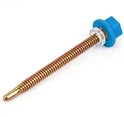
Our Double-Thread Self-Drilling Screws feature a secondary thread under the head with a higher pitch. This design locks the outer sheet and the inner structure together, preventing the "pumping effect" caused by wind loads that eventually loosens the washer's grip.

Technical Specifications & Size Chart
To help you select the right fastener for your roofing project, refer to our standardized engineering data below:
| Product Name | Gauge & Diameter | Length Range | Drilling Capacity | Washer Specification | Primary Application |
| Hex Double Thread Screw | #12 (5.5mm) / #14 (6.3mm) | 75mm - 350mm | Up to 12.5mm Steel | 16mm / 19mm EPDM | Heavy Sandwich Panels |
| Roofing Stitch Screw | #10 (4.8mm) / #12 (5.5mm) | 20mm - 35mm | 2mm - 4mm Steel | 14mm EPDM Bonded | Lap Joint Sealing |
| Resin Tile Screw | #14 (6.3mm) | 75mm - 150mm | Wood / Light Steel | Waterproof Cap + EPDM | Corrugated Plastic/Resin |
Professional Lab Data (Quality Control)
Every batch of Dongchao EPDM-bonded washers undergoes rigorous testing to meet international construction standards:
Hardness (Shore A): 65-75 (Optimized for metal-to-metal sealing).
Tensile Strength: ≥ 10.5 MPa.
Ozone Resistance: 50 pphm (No cracks under 72-hour exposure).
Salt Spray Resistance: Available with Ruspert or Dacromet coating for 500-1500 hours protection.

Expert Summary
Don't let a $0.05 washer ruin a $50,000 roofing contract. Choosing the right EPDM specification and ensuring correct installation torque are the two most cost-effective ways to prevent leaks.
Need a custom length for high-insulation panels? Dongchao Hardware specializes in extra-long fasteners (up to 350mm) that most factories cannot produce.
Contact our Engineering Team at david@dcscrews.com for a technical consultation or a free sample kit.