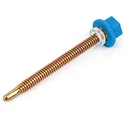
Steel Structure Fastener Selection: Why Specs Fail and How to Choose the Right Screw
Introduction
Most selection guides focus on specifications. In reality, failures in steel structure projects are rarely caused by "wrong size" - they are caused by mismatched performance.

From factory-side feedback and job-site reports, three problems account for over 80% of claims:
Screw cannot penetrate steel within expected time
Premature corrosion within 6–18 months
Head breakage during installation
This guide cuts through the jargon to explain why these failures happen and provides a technical framework for correct selection.
1. Drilling Failure Is Not About Length - It's About Tip Design

Many buyers assume longer screws mean stronger performance. This is incorrect. The real factor is drill point geometry + hardness matching.
Key engineering facts:
Drill point hardness must exceed base material by ~3–5 HRC.
Improper heat treatment leads to tip wear before penetration or overheating (loss of hardness).
Real scenario:
For 3–5mm steel purlins, a #3 drill point often struggles under continuous installation, whereas a #4 provides stable penetration and reduces torque load.
Pro Tip: This is why experienced contractors prefer "over-spec" drill points in large projects to mitigate risk.
2. Torque vs. Tensile Strength: The Hidden Trade-off
A common misunderstanding is: "Higher hardness = better screw."
In practice, balance is key.
Higher hardness: Better drilling, but lower ductility → higher risk of head snapping.
Factory Standard Balance: Core hardness (HRC 28–32) vs. Drill tip (HRC 45–52).
If the entire screw is too hard, it drills well but fails during tightening. If too soft, it won't penetrate.
3. Corrosion Failures: Thickness > Coating Type
Many buyers focus on coating names (Ruspert, Dacromet, Geomet). However, field data shows failure is usually due to insufficient coating thickness or poor process control.
| Coating Type | Typical Salt Spray | Real Issue to Watch |
|---|---|---|
| Zinc Plated | 24–72h | Often too thin for structural use |
| Ruspert | 500–1000h | Check for process stability |
| Dacromet/Geomet | 1000h+ | High cost, verify consistency |

Field Feedback: Roofing projects in coastal areas often fail not because of the wrong coating type, but because the coating thickness is below the required spec.
4. Bimetal Screws: Not Always the Best Choice
The market trend is pushing bimetal screws heavily, but they are often overused.
When Bimetal is Necessary: Coastal environments, chemical plants, solar projects (25-year lifespan requirement).
When it is NOT: Indoor steel structures, dry industrial environments.
Cost Alert: Over-specifying bimetal can increase your BOM cost by 2–3x with no real benefit in dry environments.
5. Installation Speed Is a Hidden Cost Factor
From contractor feedback, poor drilling screws increase installation time by 20–40%.
Higher torque → faster tool wear.
Frequent bit replacement.
In large projects, the labor cost of slow installation often exceeds the price difference of the screws themselves.
6. Failure Case Study: The "Wrong Spec" Trap

A roofing project in Southeast Asia used #2 drill point screws for 2.5mm steel.
The Result:
Installation time doubled.
12% screw failure rate.
Costly rework required.
The Fix: After switching to #3 drill point, installation efficiency improved by 35% and the failure rate dropped below 2%. The issue was not quality - it was incorrect specification.
[H2] 7. Practical Selection Logic
Instead of asking "Which screw is best?", use this checklist:
Steel Thickness:
≤2mm → #2 Point
2–4mm → #3 Point
4–6mm → #4 Point
Environment:
Outdoor → Ruspert / Dacromet
Coastal → Bimetal
Lifespan Requirement: Match coating thickness to years of service.

Frequently Asked Questions
Q: Can I use a #3 drill point for 2mm steel?
A: Yes, but it may cause "walking" or larger holes. A #2 point is optimized for thinner gauge steel.
Q: Why do screw heads snap during installation?
A: This is usually caused by excessive core hardness (lack of ductility) or using a drill point meant for thicker steel on thin material, creating too much resistance.

Conclusion
Fasteners are often treated as low-value components, but in steel structures, they directly affect installation efficiency and long-term reliability.
Correct selection is not about choosing the "strongest" screw, but the most appropriate combination of drilling capacity, hardness balance, and corrosion resistance.