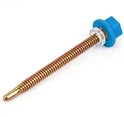
Concrete Screws vs Anchors: Not a Simple Replacement Choice
In many projects, concrete screws and anchors are treated as interchangeable solutions.
On paper, both are used for fixing into concrete - but on site, they behave very differently.
The issue is not which one is "better", but which one performs reliably under specific conditions.
From installation crews and distributor feedback, incorrect selection between these two fastening methods is one of the most common causes of:
Loose connections after installation
Unexpected pull-out failures
Increased labor time due to rework
This guide focuses on real-world performance, not just catalog specifications.

How Concrete Screws Actually Work
Concrete screws rely on thread-forming engagement.
After drilling a pilot hole:
The screw cuts into the concrete wall
Threads create friction and mechanical interlock
Dust is displaced into the hole
There is no expansion force involved.
What this means in practice:
Lower stress on concrete edges
Suitable for close-to-edge applications
Easier removal and reinstallation
However, holding strength depends heavily on:
Hole accuracy
Concrete density
Installation torque

How Anchors Work (And Why They Hold More Load)
Anchors function differently depending on type:
Expansion Anchors
Expand outward under tightening
Create radial pressure inside concrete
Chemical Anchors
Bond with concrete using adhesive
Transfer load through adhesion and friction
Result:
Anchors generally provide:
Higher load capacity
More stable performance in structural applications
But they also introduce:
More installation steps
Higher dependency on correct procedure
Load Capacity: Where the Real Difference Appears
In most real applications:
Anchors outperform concrete screws in heavy load conditions
Concrete screws are sufficient for light to medium-duty fixing
Typical guideline (practical, not theoretical):
Light-duty (cable trays, brackets) → screws are sufficient
Medium-duty (frames, profiles) → depends on embedment
Heavy structural loads → anchors are required
The mistake many buyers make is choosing screws for applications where load safety margin is too low.

Installation Time and Efficiency
From contractor feedback:
Concrete screws reduce installation time significantly
No need for expansion control or curing time
Easier alignment adjustments
In large-scale projects:
Time savings can be substantial, especially in:
Repetitive installations
Interior systems
Temporary structures
Anchors, on the other hand:
Require more steps
Demand higher installation accuracy
Increase labor cost

Failure Risk: What Actually Goes Wrong on Site
Concrete Screws Fail When:
Pilot hole is too shallow
Hole diameter is incorrect
Concrete strength is inconsistent
Over-torque damages threads
Anchors Fail When:
Expansion is incomplete
Hole cleaning is ignored (very common)
Chemical anchors are not cured properly
Important insight:
Screw failures are often immediate,
Anchor failures are often delayed - which is more dangerous.
Edge Distance and Material Sensitivity
Concrete screws have a major advantage:
Minimal expansion pressure
Lower risk of cracking
This makes them suitable for:
Edge fixing
Thin concrete sections
Precast elements
Anchors, especially expansion types:
Can induce cracking
Require minimum edge distance
Cost Is Not Just Product Price
Many buyers compare only unit price.
But real cost includes:
Installation time
Tool wear
Failure rate
Rework cost
In practice:
Screws = lower upfront + faster installation
Anchors = higher cost + higher load security
The correct choice depends on total project cost, not just material price.

When to Use Concrete Screws
Concrete screws are the better option when:
Fast installation is required
Load is moderate
Re-adjustment may be needed
Edge distance is limited
Indoor or controlled environment
Typical applications:
Cement board fixing
Electrical systems
Light steel structures
Interior installations
When Anchors Are the Safer Choice
Anchors should be used when:
Load-bearing requirements are high
Safety is critical
Long-term structural stability is required
Outdoor or harsh environments are involved
Typical applications:
Structural steel connections
Heavy equipment installation
Suspended systems
Seismic or dynamic load conditions
A Practical Selection Approach (Used by Experienced Buyers)
Instead of asking:
"Which one is better?"
Ask:
What is the load requirement?
Is the fixing permanent or adjustable?
How important is installation speed?
What is the concrete condition?
This approach avoids most selection mistakes.
Conclusion
Concrete screws and anchors are not competing solutions - they serve different purposes.
Concrete screws offer speed and flexibility.
Anchors provide strength and long-term reliability.
Choosing the right fastening method is not about preference, but about matching performance to real application conditions.