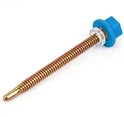
A contractor sent back a pallet once. The complaint ran to two words: "these leak".
We checked them. Dimensionally correct, coated correctly, drilled fine. The problem was a 2 mm ring of rubber bonded to the underside of the head, and it had been bonded badly - a glue line that let go after two summers on a roof in the UAE.
Nobody buys screws for the washer. That's exactly why it fails.
Four jobs at once
On metal roofing fasteners the EPDM washer is the only sealing element, and it's asked to do four things at once.
It fills the gap between head and profiled sheet. A trapezoidal profile puts the fastener on a crest or in a pan - different geometry, different gap.
It holds compression through thermal cycling. A panel moves daily, and the washer has to stay elastic through that, not seal on the afternoon it went in.
It resists compression set, because rubber with a permanent set has stopped being a spring. What's left is interference instead of recovery, and that leaks within a few seasons. Usually the third.
And it survives. UV at the surface, heat at the surface, bitumen from whatever the trades did nearby.
Bonded, loose, and glued
A loose washer sits on the shank and rotates freely. Cheaper, and a choice with a consequence: during driving it can stay still while the head turns on it. Fine on a smooth head. On a serrated one, or if it gets dragged, it distorts before the head seats.
A bonded washer is vulcanised to the underside of the head. It can't rotate, can't be displaced, and seals on the axis it was designed for. Costs more.
On a vertical wall the difference is small. On a low-slope roof in wind-driven rain, a loose washer that walked 1 mm during driving is a leak path no inspection will find, because you can't see under a seated head.
So the question isn't whether it has a washer. It's whether the rubber is bonded or free, and whether the bonding is vulcanised or glued. Glued ones exist in volume, they delaminate after two summers, and they look identical on a datasheet.
Reading an EPDM spec
Four parameters, none of which appear on a standard screw datasheet.
Hardness, typically 70 to 80 Shore A. Softer and it extrudes under clamp load. Harder and it won't conform to the profile.
Compression set, the permanent deformation left after a defined time at temperature. That's the number predicting a leak in year three, and it's almost never quoted. Ask for it.
Temperature range. Standard EPDM handles roughly -40 to 120 °C continuous. Sounds generous until you picture a dark metal roof in a hot climate, where the surface under a washer sits at 70 to 80 °C for hours. Compression set accelerates sharply with heat, so "rated to 120" and the real condition are different conversations.
UV and ozone resistance, where EPDM is good. That's why it's the default, and why substitutes are a false economy.
Here's the test I use. Ask for the compound designation and the compression set figure. A supplier who names a compound is buying to a specification. A supplier who says "good EPDM" is buying on price.
Where the water gets in
Four causes, and only one of them is a defective washer.
Compression set from over-driving is the most common by a distance. The head went down until the washer flattened, the elastic range went with it, and the thing sealed that day and leaked in year two.
Under-driving is the mirror image. The washer never reached the compression it needed, usually because a crew was told not to over-drive and over-corrected.
Off-axis installation. A screw driven at an angle compresses one side of the washer and barely touches the other. Easy on a profiled sheet, hard to see afterwards.
Wrong position on the profile. Pan instead of crest, or the reverse, changes the sealing geometry and on some profiles builds a water trap at the fastener.
Three of those four are installation, not product. Which is why a washer specification without an installation specification gets beaten by technique every time.
Three things a crew can check
The washer is visibly compressed and the compression is even all round. A slight bulge at the perimeter is right. A flattened ring is over-driven.
The head is seated with no gap and the sheet isn't dished. Dishing means the panel was deformed to meet the screw, and the seal is now working against a shape it wasn't designed for.
The screw is perpendicular to the bearing surface - the local panel surface, not the ground. Crews get that wrong more than you'd think.
On a big roof, spot-check ten per hundred. It takes a minute and catches a bad clutch setting before it produces two thousand roofing screws.
On the order
Screw spec plus washer spec, as two separate things: material and compound designation, hardness in Shore A, bonded or loose and the bonding method, compression set, temperature range, and whether the washer is assembled and inspected as one part.
That last one is commercial, and it gets skipped. A supplier who assembles and inspects the washer onto the self drilling screw is selling a sealing system. A supplier who ships screws in one box and washers in another is selling components and handing assembly quality to whoever's on the tools that morning.
Handan Dongchao Hardware Products Co., Ltd. has been cold heading and thread rolling in Handan, Hebei since 2008, at around 600 tonnes a month across 100 cold heading machines, 75 thread rollers, 30 tail drilling machines and two heat treatment furnaces. For roofing families the washer is specified and inspected as part of the finished screw, because a leak gets blamed on the fastener whatever actually caused it. ISO and CCC certified, exporting into the US, UK, UAE, Saudi Arabia, Vietnam and Korea.
The short version
The screw drills the hole. The washer keeps the water out. Only one of those is on the drawing.
Specify the washer as a sealing component, inspect compression rather than torque, and remember that the leak lives in the part nobody specified.