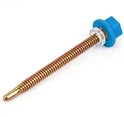
Open a fastener factory's product list. Self drilling screws, machine screws, bolts, maybe rivets. Then somewhere near the bottom, four or five drywall screw SKUs, listed as a commodity.
Now look at the volume. I've had this conversation a dozen times, and it always ends in the same place.
Two unrelated sources, one conclusion
Search demand in the United States for drywall screw and its variants runs around 49,500 monthly searches. Sheetrock screws - a trade name that outlived its trademark by several decades - carry a meaningful slice of that same intent.
Then the customs records. Drywall screws leaving China for the US appear in shipment line items more than 58,000 times. Not units. Shipment records.
One comes from a search box. The other comes from a broker's filing at a port. They have nothing to do with each other, and they land on the same answer: this is one of the biggest categories in the fastener trade by volume, and it's routinely treated as filler.
Why it gets underweighted
Three reasons, and none of them have anything to do with the product.
It's cheap per unit. A drywall screw sells for a few cents. A buyer's attention goes to the line with the big number on the invoice, even when the small line moves ten times the quantity.
It's technically boring. No drill point geometry to argue about, no bonded washer, no heat treatment beyond a basic case. The engineering conversation is over in ninety seconds, so it gets skipped.
And it's bought by distribution rather than by project. Self drilling screws get specified by an engineer and purchased against a schedule. Drywall screws get replenished by a branch manager when the box runs low. Replenishment demand is invisible in a specification-driven sales process, which is how a factory ends up with five SKUs and no strategy.
What the demand is actually made of
Break the volume down and the SKU count is wider than most catalogues carry.
Length first. 25, 32, 35, 41 and 51 mm cover most of the market, with 25 and 35 doing the heavy lifting. A single layer of 12.5 mm board on a steel stud lands on 25 mm. The same board on timber lands on 35 mm.
Thread splits the family in two. Fine thread for steel stud, coarse for timber. They aren't interchangeable, and they get substituted constantly by buyers who were never told why the distinction exists.
Heads run bugle as standard, wafer where a wider bearing face is wanted, countersunk for wood trim work.
Coating is black phosphate for dry interior work, zinc or a coated finish for wet areas and exteriors. And the standard underneath it all is DIN 18182 in Europe and ASTM C1002 in North America - same screw on the shelf, different inspection criteria behind it.
Five dimensions. A catalogue carrying two lengths, one thread and one coating is serving roughly a fifth of the demand it could reach.
The volume is won in a branch, not in a tender
A distributor deciding what to stock weighs four things, none of them on a drawing.
Does the collation work in the auto-feed gun. Does the coating survive handling without rusting in the box. Is the point consistent enough that the crew stops complaining about it. And will the manufacturer hold stock so a reorder ships in days rather than weeks.
Read that list again. It's a manufacturing list wearing a service list's clothes. Collation consistency is quality control. Coating durability in the box is process control. Point consistency is tooling wear. Stockholding is capital.
Which is why the category consolidates around a few suppliers who took it seriously, and everyone else competes on price.
The margin problem nobody wants to say out loud
There's a reason beyond inattention. Margin per unit is thin, and thin margins reward exactly one thing: volume with low variance.
A factory making drywall screws profitably isn't making them cleverly. It's making them fast, with high die life, low scrap and minimal changeover. Changeover is the enemy. Every specification switch costs setup time on the header and the roller, and on a four-cent part, setup is a bigger share of the price than on a forty-cent one.
Which explains the SKU paradox nicely. Factories carry few drywall specifications not because demand is narrow but because each extra SKU costs more in changeover than it returns in sales. The ones who solved it did it by dedicating machines - running a small set of high-volume specs continuously on dedicated headers instead of cycling one machine through twenty setups a week.
I'd make that a standing question for any supplier. Ask which specifications run continuously and which are made to order. Continuous is cheaper and more consistent. Made-to-order carries a setup charge that's either quoted openly or buried in the unit price.
What changes if you take it seriously
Consolidate the SKU set deliberately. Two threads across five lengths is ten SKUs and covers most of the trade.
Specify coating by performance rather than colour. "Black" isn't a coating specification. Ask for the phosphate class, and for anything with damp exposure, ask about a zinc or zinc flake alternative.
And check the collation if your customers run auto-feed guns, because the collated strip is the product at that point. A screw that jams once in 200 costs more than it saves.
For a manufacturer the shift is simpler: consistency at scale, not engineering novelty. Nobody wins this with a clever feature. They win by shipping the same screw, on time.
Handan Dongchao Hardware Products Co., Ltd. has cold headed and thread rolled in Handan, Hebei since 2008, at around 600 tonnes a month on 100 cold heading machines and 75 thread rollers. Drywall screws are a heading and rolling product end to end, which makes them a volume-and-consistency business rather than a design one. ISO and CCC certified, exporting into the US, UK, UAE, Saudi Arabia, Vietnam and Korea.
The short version
The category is enormous, unglamorous, and under-served because it's unglamorous.
If you're deciding where to put inventory capital this quarter, the part that sells for four cents and appears 58,000 times in shipment records is a better answer than the part that photographs well in a fastener export catalogue.