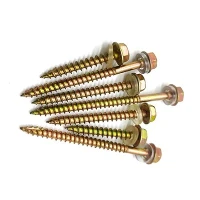
Hey there! As a bolt supplier, I've seen all sorts of bolts in my time. Bolts are super important in construction, manufacturing, and a whole bunch of other industries. They're like the unsung heroes that hold things together. So, let's dive into how many types of bolts there are.
1. Hex Bolts
Hex bolts are one of the most common types of bolts out there. You can recognize them by their six - sided heads. They're used in a wide range of applications, from building structures to machinery.


There are different grades of hex bolts. For example, High Strength Hex Bolts Grade 8.8 10.9 12.9 Manufacturer | Heavy Duty Fasteners. Grade 8.8, 10.9, and 12.9 are high - strength hex bolts. These are used when you need a bolt that can handle a lot of stress. They're often used in heavy - duty construction projects, like bridges and large buildings.
On the other hand, we have Grade 2 & Grade 5 Hex Cap Bolt UNC Zinc Plated Full Threaded Supplier. Grade 2 and Grade 5 hex cap bolts are less strong compared to the high - strength ones. They're zinc - plated, which gives them some corrosion resistance. These are commonly used in general - purpose applications, like assembling furniture or small machinery.
2. Carriage Bolts
Carriage bolts have a round head with a square section under the head. The square section prevents the bolt from turning when you're tightening the nut. They're often used in wood - to - wood or wood - to - metal connections. You'll see them a lot in outdoor structures like decks and fences. They're great because they provide a smooth finish on the surface, which is important for things like furniture where you don't want sharp edges.
3. Anchor Bolts
Anchor bolts are used to attach objects to concrete. They come in different shapes and sizes. Some are straight, while others are bent. They're crucial in construction, especially for attaching columns, machinery, and other heavy equipment to the concrete foundation. The way they work is by being embedded in the concrete, and then the object is attached to the exposed part of the bolt. This ensures that the object is firmly fixed to the ground.
4. U - Bolts
U - bolts are shaped like the letter "U". They're used to secure pipes, round bars, or other cylindrical objects. You'll often see them in automotive applications, like securing leaf springs to the axle. They're also used in plumbing to hold pipes in place. The two ends of the U - bolt are threaded so that nuts can be used to tighten them around the object.
5. Eye Bolts
Eye bolts have a loop or an "eye" at one end. They're used for lifting or attaching ropes, cables, or chains. You can find them in warehouses, factories, and construction sites. For example, if you need to lift a heavy piece of equipment, you can attach a hook to the eye of the bolt and then use a crane or a hoist to lift it.
6. Specialty Bolts
There are also specialty bolts designed for specific applications. One example is the Tunnel Segment Bolt HDG Curved Bolt Manufacturer for Tunnel Construction. These bolts are used in tunnel construction. They're hot - dip galvanized, which gives them excellent corrosion resistance. The curved shape is designed to fit the curvature of the tunnel segments.
7. Stud Bolts
Stud bolts are basically bolts without a head. They have threads on both ends. They're used when you need to attach two parts together and one of the parts has a threaded hole. You screw one end of the stud bolt into the threaded hole, and then you use a nut on the other end to secure the second part. They're commonly used in flanged connections, like in pipes and valves.
8. Machine Bolts
Machine bolts are similar to hex bolts, but they usually have a finer thread. They're used in machinery and equipment. They can be used with nuts or in pre - threaded holes. They're often used in applications where a precise fit is required.
9. Lag Bolts
Lag bolts are large, heavy - duty bolts with a wood - screw thread. They're used for attaching heavy objects to wood. They're often used in construction, like attaching beams to posts. You need to drill a pilot hole before inserting a lag bolt to ensure a good fit.
10. Socket Head Cap Screws
Socket head cap screws have a cylindrical head with a socket drive. They're used in applications where you need a low - profile fastener. They're often used in machinery and automotive applications. The socket drive allows for a more secure and precise tightening.
As you can see, there are a ton of different types of bolts, each with its own unique features and uses. Whether you're working on a small DIY project or a large - scale construction job, there's a bolt out there that's perfect for the task.
If you're in the market for bolts, whether it's high - strength hex bolts, specialty bolts for a specific project, or any other type, I'd love to help you out. We have a wide range of bolts in different sizes, grades, and materials. Just reach out to us, and we can have a chat about your requirements. We're here to make sure you get the right bolts for your job.
References
- Machinery's Handbook, Industrial Press Inc.
- Fasteners: A Practical Guide, ASM International