




Not All "Self-Tapping" Cement Screws Work Without Drilling


In many product listings, cement screws are described as "self-tapping," which often leads to misunderstanding on site.
In reality, most cement screws do not drill into concrete directly.
They require a pre-drilled hole, and then form threads inside the material during installation.
This distinction is critical - incorrect usage is one of the most common reasons for fastening failure.
Features
Drive Type
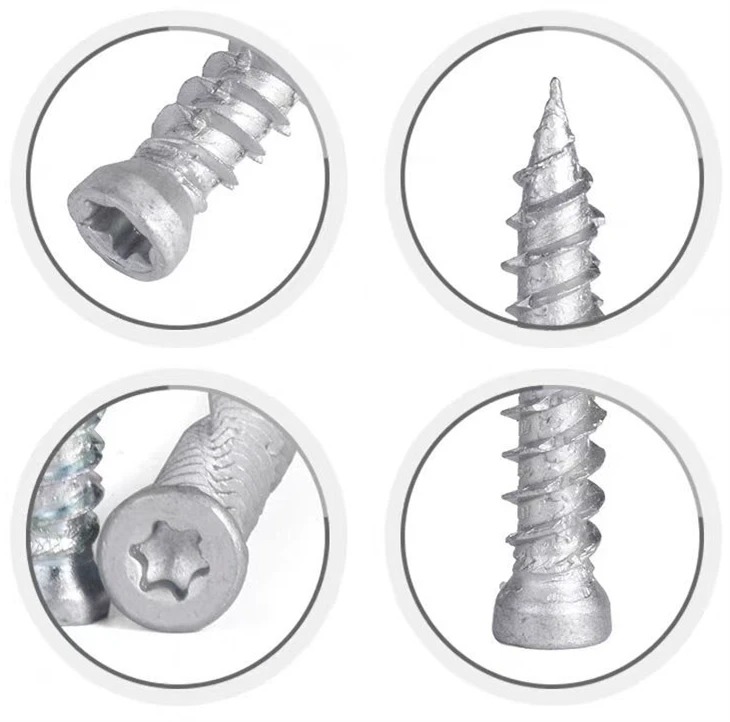
Torx/Star drive for reduced cam out and high torque transfer.
01
Head Styles
Flat countersunk head, hex washer head, or pan head options.
02
Thread Design
Hardened, deep-cutting threads for maximum grip in concrete and masonry.
03
Coating
Zinc-plated, Ruspert-coated, or stainless steel for corrosion resistance.
04
Installation
No expansion stress; reduces risk of cracking in brittle substrates.
05
Technical Properties
- Material: Carbon steel, case hardened.
- Breaking Torque: Designed to handle high tightening loads without head stripping.
- Tensile Strength: Approx. 800–1000 N/mm² depending on grade.
- Shear Load Capacity: Suitable for medium to heavy-duty fixings.
- Drilling Capacity: Can cut threads directly into concrete or masonry after pre-drilling a pilot hole (commonly 4–6 mm smaller than screw diameter).
Concrete Self-Tapping Screws (7.5mm Series)
| Size (mm) | Packing (pcs) | Weight (g/pc) | Drill Hole Size (mm) | Typical Application |
|---|---|---|---|---|
| 7.5 × 42 | 2000 | 7.44 | 6.0 | Cement board fixing |
| 7.5 × 52 | 2000 | 9.16 | 6.0 | Light concrete fixing |
| 7.5 × 62 | 2000 | 10.88 | 6.0 | Brackets / profiles |
| 7.5 × 72 | 1600 | 12.60 | 6.0 | Wall installation |
| 7.5 × 82 | 1600 | 14.32 | 6.0 | Medium-duty fixing |
| 7.5 × 92 | 1200 | 16.04 | 6.0 | Concrete wall |
| 7.5 × 10² | 1200 | 17.76 | 6.0 | Steel to concrete |
| 7.5 × 112 | 1000 | 19.49 | 6.0 | Deeper embedment |
| 7.5 × 122 | 1000 | 21.21 | 6.0 | Structural light fixing |
| 7.5 × 132 | 1000 | 22.93 | 6.0 | Frame installation |
| 7.5 × 152 | 1000 | 26.37 | 6.0 | Heavy-duty fixing |
| 7.5 × 182 | 800 | 31.53 | 6.0 | Deep concrete anchoring |
| 7.5 × 202 | 800 | 34.97 | 6.0 | Extra deep fixing |

How Cement Screws Actually Work in Concrete
Unlike expansion anchors, cement screws rely on direct thread engagement.
A pilot hole is drilled first
The screw is driven in
Threads cut into the base material
Dust is displaced into the hole
This creates a mechanical lock without expansion pressure.
Advantage: suitable for edge fixing and brittle materials
Where Cement Screws Are Commonly Used (Real Applications)
Cement board fixing
Light steel to concrete
Electrical brackets
HVAC installations
Interior partition systems
These are non-heavy-load applications, where speed and removability matter more than load capacity.

Why Cement Screws Fail (Real Job-Site Problems)
1. No pilot hole
Trying to drive directly into concrete leads to:
Tip damage
Screw breakage
No holding strength
2. Hole depth is insufficient
Concrete screws require:
hole depth > screw embedment
Otherwise:
Dust blocks thread formation
Torque increases sharply
3. Wrong base material
Not suitable for:
Cracked concrete
Low-density blocks
Edge installation
Failure in these conditions is very common in renovation projects.

Selection Logic (This is what buyers actually need)
Instead of asking:
"Which cement screw is best?"
Ask:
Step 1 – Base material
Dense concrete → standard
Hollow block → limited performance
Step 2 – Load requirement
Light fixing → OK
Structural load → use anchors
Step 3 – Environment
Indoor → zinc plated
Outdoor → coated / stainless
Important Limitation (Most Suppliers Don't Tell You)
Cement screws are not recommended for overhead tensile loads.
This includes:
Suspended piping
Ceiling heavy installations
Because failure may lead to safety risks.
Conclusion
Cement screws are efficient fastening solutions - but only when used correctly.
They are not universal replacements for anchors, and not truly "drill-free" fasteners.
Understanding how they interact with concrete is the key to avoiding failure and ensuring long-term performance.
Still Unsure Which Specification Fits Your Project?
Don't risk installation failures due to wrong specs.
Send us your drawing or application details. Our engineering team will review your requirements and recommend the correct drill point, hardness, and coating within 12 hours.
Free Technical Consultation
Custom Sizes & OEM Support
Factory-Direct Pricing
Hot Tags: Concrete Self-Tapping Screws for Cement Board & Masonry Fixing (Pre-Drilled Application), China Concrete Self-Tapping Screws for Cement Board & Masonry Fixing (Pre-Drilled Application) manufacturers, suppliers, Oval Head Self Drilling Screw, Extra Tough Self Drilling Screw, Round Washer Self Drilling Screw, Firm Connection Self Drilling Screw, Powder Coated Self Drilling Screw, Slotted Hex Washer Head Self Tapping Screws


